Area 8: Robotics
Robot NAO
- Available Quantity: 1 unit
- Official Supplier: Alisys Digital S.L.U.

Subjects
- Biomechanics and Neural Control of Movement
- Biomedical Instrumentation and Robotics
- TFG
Technical Description
The NAO robot is an autonomous, programmable humanoid robotics platform developed for advanced research, education, and human-robot interaction (HRI). Featuring a highly articulated bipedal structure with multiple degrees of freedom, integrated vision systems, and directional microphone arrays, NAO excels at tracking movement, recognizing facial features, and processing speech. Within biomedical engineering, it serves as an excellent benchmark tool for studying gait dynamics, neural control algorithms, cognitive modeling, and assistive healthcare robotics designed for patient rehabilitation or social therapy.
Technical Features & Capabilities
- Omnidirectional Humanoid Kinematics: Equipped with 25 degrees of freedom allowing fluid, complex motor patterns, balance stabilization, and whole-body coordination tracking.
- Multimodal Perception Array: Features specialized HD cameras, sonar sensors, and tactile touch zones to capture precise environmental feedback in real time.
- Active Text-to-Speech & Audio Localization: Utilizes multiple microphones and speakers to track vocal direction and sustain interactive dialogue cues.
Software & Integration
- Compatible Software: Choregraphe (Proprietary software).
- Functionality: Powered by the Choregraphe visual programming environment, enabling developers to build behavioral trees, execute inverse kinematics models, test timelines, and deploy complex interactive scripts effortlessly.
Robot Reachy
- Available Quantity: 1 unit
- Official Supplier: Pollen Robotics
Subjects
- Biomechanics and Neural Control of Movement
- Biomedical Instrumentation and Robotics
- TFG
Technical Description
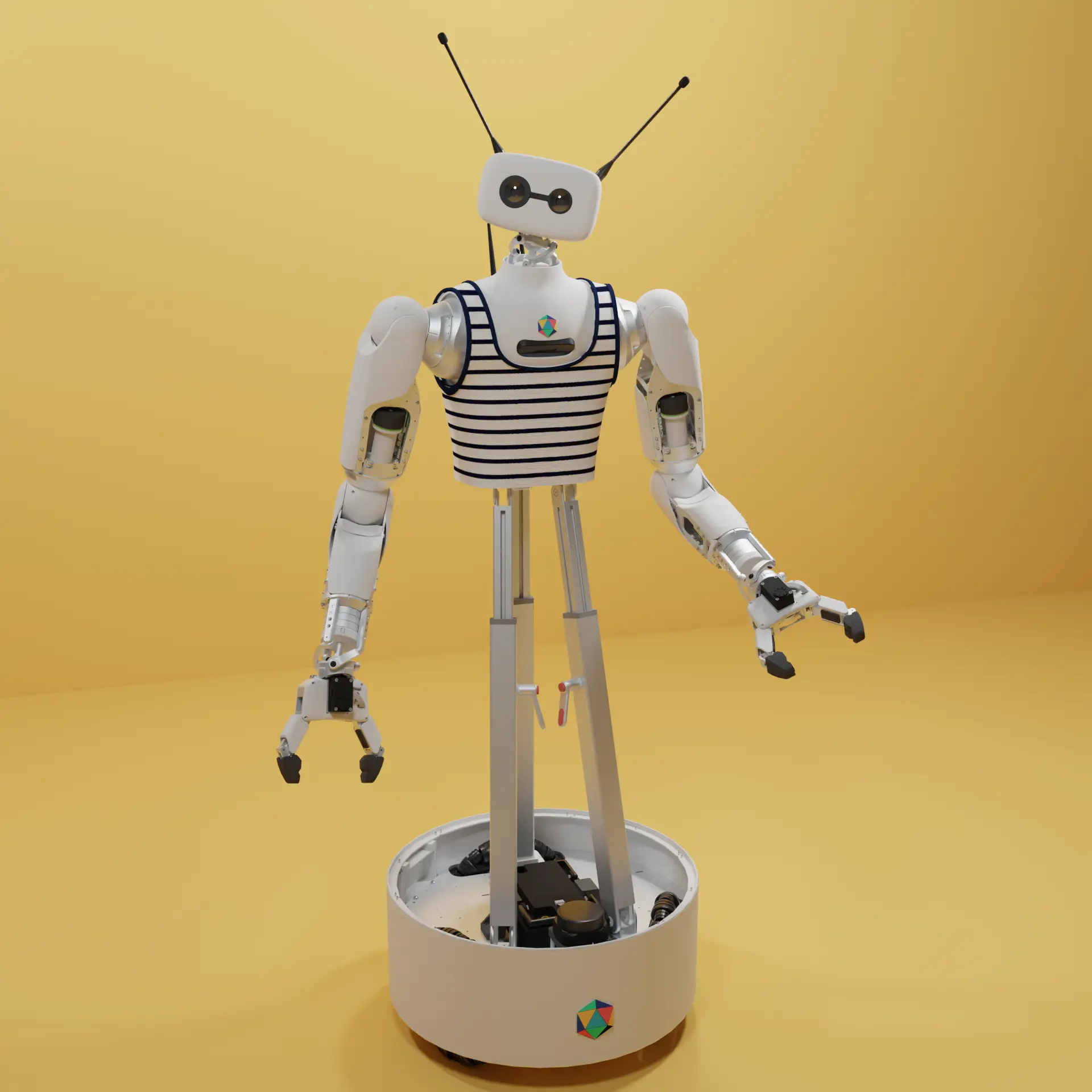
Reachy is an open-source, highly expressive humanoid robot platform optimized for real-world interaction, teleoperation, and advanced artificial intelligence research. Featuring bio-inspired, multi-jointed robotic arms with unique neck dynamics, Reachy replicates natural human arm gestures and upper-body ergonomics with impressive fidelity. It provides a robust, accessible playground for biomedical fields exploring prosthetics development, upper-limb biomechanics simulation, neural control interfaces, and human-in-the-loop collaborative tasks.
Technical Features & Capabilities
- Bio-Inspired Kinematic Dexterity: Engineered with advanced multi-axis arm configurations and modular grippers designed to simulate human object manipulation and grip force.
- Orbital Neck Actuation: Features a unique 3-degree-of-freedom neck mechanism that enables expressive, fluid head movements and natural gaze tracking.
- Open Hardware Architecture: Built with accessible components and high-torque motors, allowing easy hardware modifications and custom biomedical sensor attachments.
Software & Integration
- Compatible Software: ROS 2 with Python.
- Functionality: Operates entirely within the Robot Operating System (ROS 2) framework utilizing Python scripts, allowing low-latency hardware control, seamless neural network integration, and direct teleoperation mapping via VR or motion tracking setups.
Robot Tiago
- Available Quantity: 1 unit
- Official Supplier: PAL ROBOTICS S.L.
Subjects
- Biomechanics and Neural Control of Movement
- Biomedical Instrumentation and Robotics
- TFG
Technical Description
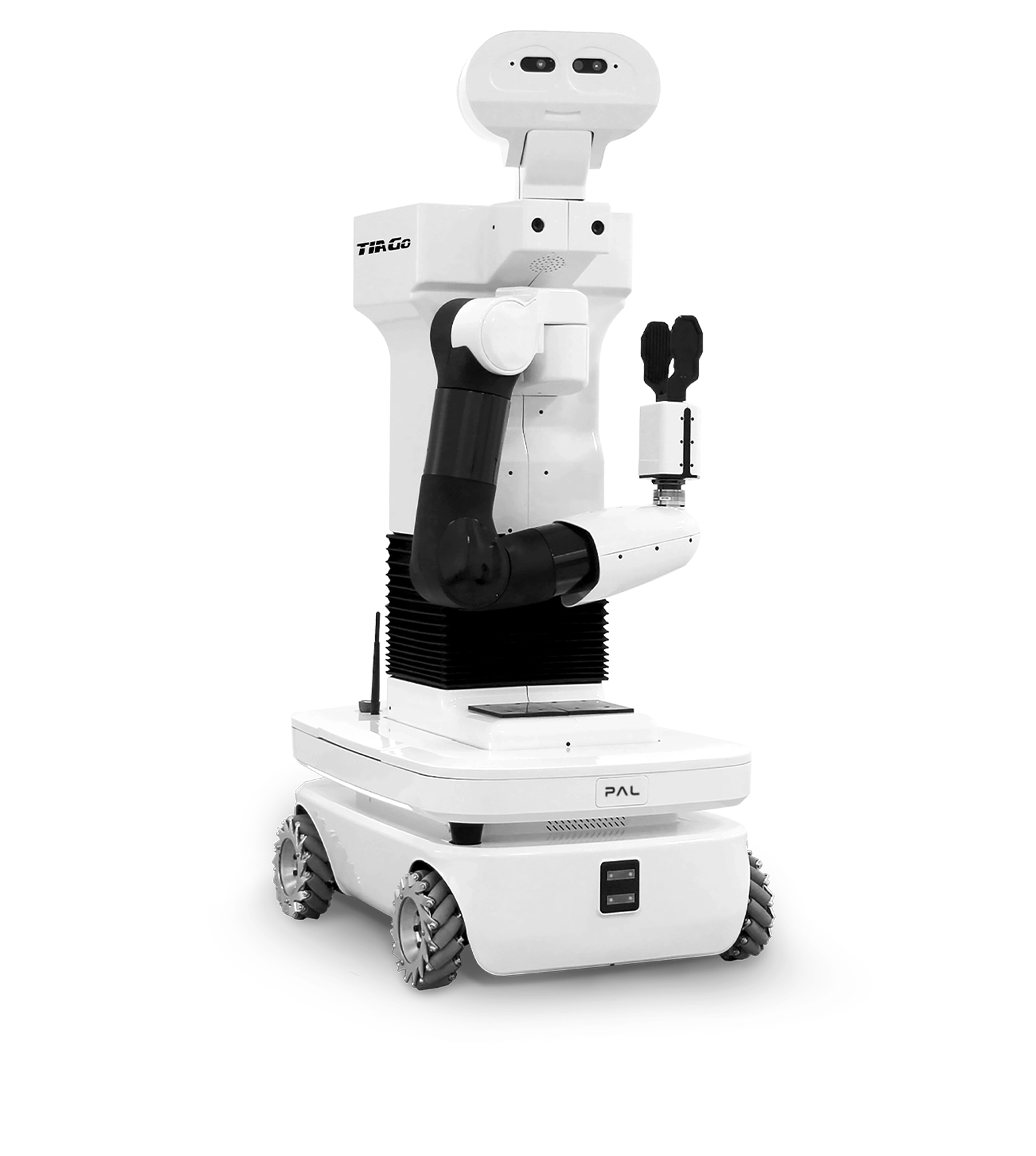
TIAGo is a collaborative, mobile manipulator robot designed to excel in complex indoor navigation and manipulation tasks within research and healthcare environments. Combining a robust mobile base with an adjustable torso and a highly precise articulated arm, TIAGo seamlessly bridges the gap between perception and physical interaction. In biomedical applications, it serves as an essential platform for testing assistive living algorithms, evaluating autonomous hospital logistics, studying whole-body biomechanical control, and developing industrial or clinical service automation workflows.
Technical Features & Capabilities
- Autonomous Mobile Manipulation: Integrates a differential drive mobile base with a high-reach articulated arm to navigate spaces and interact with environmental objects fluidly.
- Telescopic Torso Lift: Features an adjustable vertical lifting column that maximizes its operational workspace from floor level up to high shelving or counter heights.
- Advanced Perception Suite: Equipped with RGB-D depth sensors and laser scanners for precise 3D mapping, obstacle avoidance, and real-time object tracking.
Software & Integration
- Compatible Software: ROS 2 with Python.
- Functionality: Leveraging the power of ROS 2 and Python libraries, developers can implement advanced simultaneous localization and mapping (SLAM), execute precise inverse kinematics trajectories, and test autonomous navigation algorithms in simulated and physical workspaces.